Your financial data belongs to you: a case for no-account apps
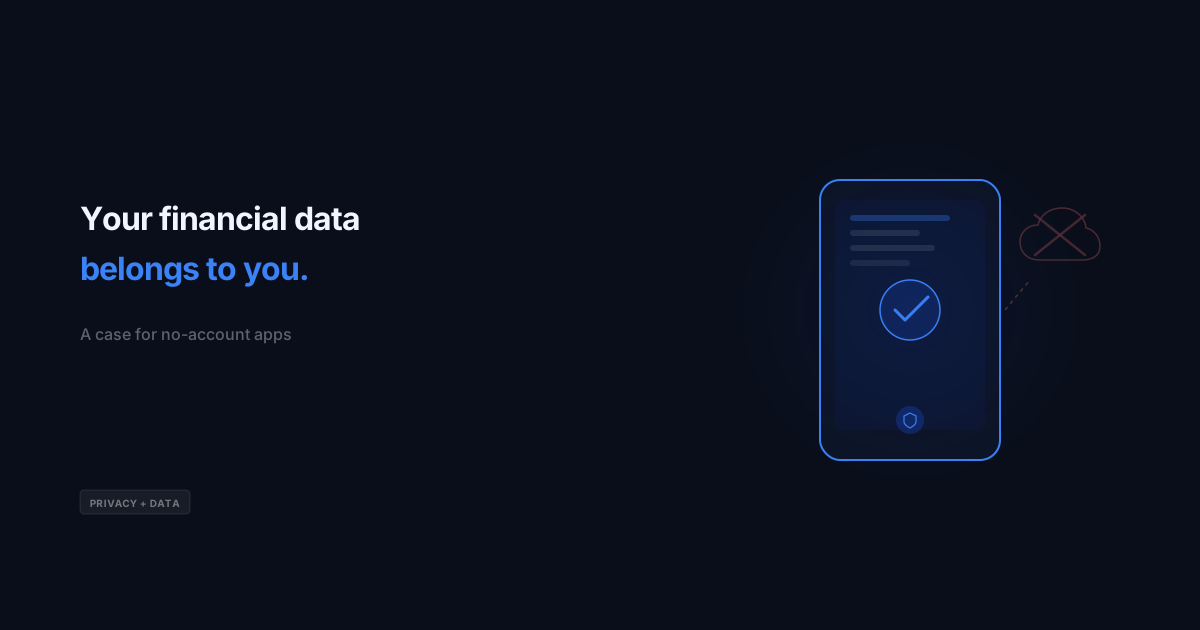
When you use a budgeting app that requires an account, you're not just signing up for a service. You're creating a record that says: here is my salary, here is what I spend on groceries, here are my SIP amounts, here are my EMIs. That record lives on a server you don't control, governed by a privacy policy you didn't read, at a company whose security posture you can't audit.
Your financial profile is someone else's data problem to manage — unless you choose differently. Most people accept this without much thought. The account requirement is presented as a feature — sync across devices, access anywhere, never lose your data. These are real benefits. But they come at a cost that rarely gets named clearly: your financial profile is now someone else's data problem to manage.
What that profile contains
A typical financial app knows
- Monthly income (exact salary)
- Investment allocation (SIPs, RDs, FDs)
- Discretionary spending patterns
- Loan repayments and EMIs
- How much you save each month
Taken together: a more precise picture of your economic life than most people share with anyone except their CA.
The persistent risk
The breach risk is real. Financial app data has been compromised before. But the more persistent risk is subtler: data that exists can be subpoenaed, sold (directly or via acquisition), analysed for advertising targeting, or simply retained long after you've stopped using the service.
0
Risks from data that was never collected
Data that was never collected carries none of these risks.
The no-account alternative
AnuPlan was built around one principle: if the app doesn't need your data, it doesn't ask for it. Salary planning doesn't require internet access. It doesn't require an account. It doesn't require your data to leave your device. The CSV and JSON export features exist so that if you want to move your data somewhere — a spreadsheet, a new app, your own backup — you can. On your terms.
No-account apps are a deliberate design choice. They trade some convenience for a guarantee: your financial data is yours, and it stays that way.
More to read
MONTH — Assembly Instructions
Your month arrives as a flat-pack kit with nine parts and one step missing. A manual for the step nobody does — written by someone who skipped it for nine years.
AnuPlanI funded every goal in July — and still ran ₹1 lakh short
I set one line to ₹1 every month — a promise that nothing would leak. In July it quietly became ₹1,08,190, and every goal still got funded. Here's how AnuAI showed me the real picture.